Postmortem: Druid Soccer

May 9th, 2007

I can’t believe it’s been already five months since my last postmortem. I’ve been skipping my responsibilities is because my postmortems have tendencies to become these huge 3000+ words long monsters. I’ll try to write this one in a more compact way, so it’s easier to read and to write.

The Development Process

Megalith

Druid Soccer was published 1st of January 2007, but I started working on it already in October 2006. The game started out as a Mario-esque platformer game. I had some random ideas I wanted to test out, so I cracked together a quick prototype where I could test these things out. While testing out my Mario physics I happened to discover that balancing and bouncing a huge box on top of the player character was actually really fun. So I thought to myself, that if this balancing a box thing is fun, it would be twice as fun if there where two players. And thus Druid Soccer was born.

Well actually it wasn’t called Druid Soccer. The game lacked a theme. I tested the early prototype with my friends and got a very good response from them. Everybody enjoyed it, but it wasn’t until December 2006 that I started working on the game again. And it was then when I decided that I’d skin the game as a druid soccer.

What Went Right

1. Building the toy first
A blue-square-prototype of the game really helped me balance out and tweak little things in the game. And also I got to test the game with my friends and get some initial feedback on the idea. Something I rarely get to do with my prototypes. The game would have never been made if I hadn’t tested the early version with my friends. That’s the price you got pay for creating a two player game. The playtesting takes a lot more time and people, than it does in a single player game.

2. The simple but deep gameplay
Even though the game has a very simple idea and controls, the game has surprisingly deep gameplay. Because of the physics there are all these small cool little tricks that you learn to do. Ways to get the bolder out of your opponents grip, how to throw the boulder from the middle of the playground, etc…

3. The right theme
I think I managed to pick a pretty decent theme for the game. At least for some people it’s been the theme that got stuck in their head. I was also lucky enough to happen to stumble upon some really create Celtic Creative Commons music: The Dongas Tribe.

What Went Wrong

Even though I had lots of fun testing the game with my friends, the feedback that I got from the game wasn’t overly positive. I was actually little surprised by the feedback I got after the game’s release. Here’s why I think the game didn’t go over as well as I had hoped.

A druid

1. Two player game
I think the fact that the game has to be played by two players on the same keyboard, was one of the biggest reasons why the game got so little attention. The game has a single player mode where you play against the computer, but the AI is crappy, and it’s not the same experience to play it against the AI than to play it against your friend.

2. No Juiciness
The second reason I think is the fact the game has a serious lack of juiciness. There are no sound effects or particle effects or stuff like that. There’s very little animation and there’s actually no real award for making a goal. And also somebody pointed out that the game lacked my trademark, which is the big bonuses that drop from the top of the screen (as in Cacodemon and Pluto). I had too much trust in the original prototype, so I thought that game would be enjoyable even with out all that juiciness.

3. Too many nasty bugs
Unfortunately in the final release of the game, there are game stopping bugs. The physics model wasn’t stable enough with the fact that the players were teleported to their goal areas when they made a goal. I didn’t realize this in time, so the game had a bunch of really nasty bugs.

Conclusion

Overall the game is one that has a lot of potential, but I’m afraid that the single player version of the game doesn’t bring that out. The two player game on a same keyboard is always a hazzle to get working, but when you do it’s always fun. Druid Soccer is one of those games that I’d love to redo, so it would get the polish it deserves.
Daydreaming in the Oval Office

May 1st, 2007

It’s hard for me to believe that this is already my ninth (or tenth if you count the Divorce) done-in-under-week game. Well without further ado here’s the game.

Daydreaming in the Oval Office

Screenshot of Daydreaming in the Oval Office Screenshot of Daydreaming in the Oval Office Screenshot of Daydreaming in the Oval Office

Download
Ovaloffice.zip (3,6 Mb) (Release 1)

Instructions
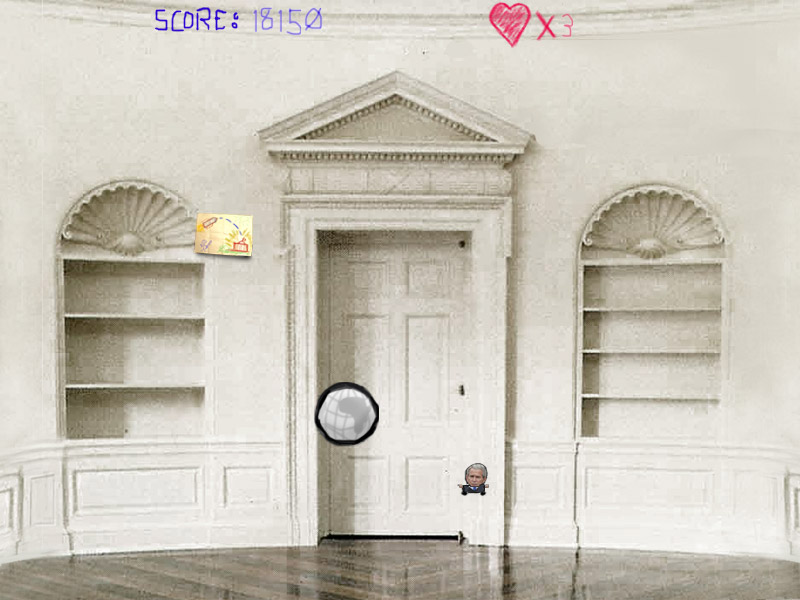
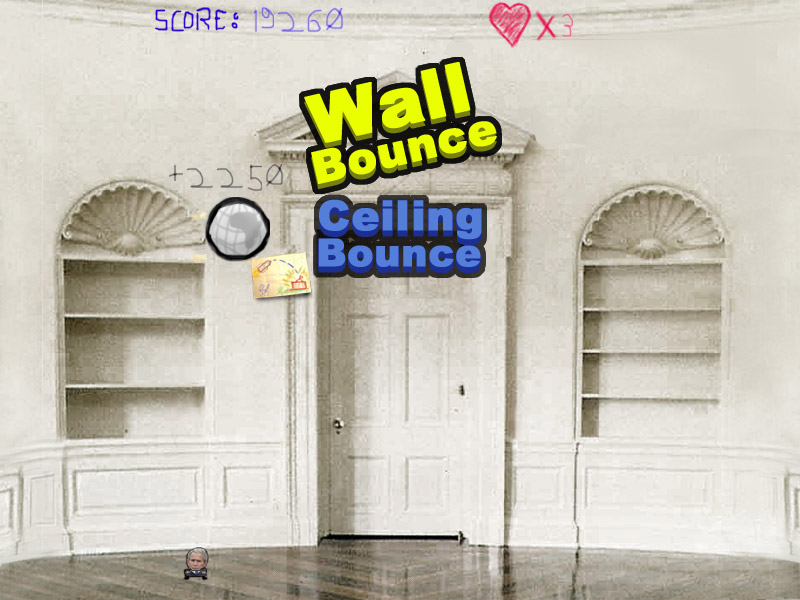
You’re mr. Bush and you’re daydreaming in the oval office. Trying to collect imaginary pieces of evidence about the Iraq’s weapons of mass destruction.

Use arrow keys to move George around. Try to keep the beach ball off the floor and try to collect the pieces of evidence.

Esc – Will quit the game.
Alt + enter – Will toggle fullscreen.

Credits
Game Design, Code & Gfx: Petri Purho ( petri.purho (at) gmail.com )
Music: Grand Old Rag, performed by Billy Murray (recorded 06 February 1906). The song is in public domain.

Also the score screen background was based on this photo by Thomas Hawk. The photograp was under the Creative Commons Attribution-NonCommercial 2.0 -license.
Also the following public domain photographs where used: 20061011-5 p101106pm-133jpg-772v.jpg by Paul Morse, OvalFloor.jpg and United_States_Bill_of_Rights.jpg.

Thanks
Physics model is based on Markus Ilmola’s tutorials.
Inspiration source: This youtube -video and Experimental Gameplay Project.
Dadreaming in the Oval Office uses: SDL, SDL_Image, SDL_Mixer and SDL_RotoZoom

Wanted: Constructive Criticism

April 6th, 2007

While surfing the intertubes I bumped into this Miyamoto interview cover: Miyamoto gives advice to game-design hopefuls. Basically he had two advices for us wannabe game designers: get a good well rounded education (on topics other than games) and seek criticism for your games early and often.
So now I remembered that it’s been a good while since I’ve reminded you all that I’m actually seeking harsh constructive criticism on my games. Usually the amount of comments a game gets is my only true indicator how well I did with the game. More comments equals better game, less comments equal crappier game. Just look at The Divorce, it got one comment and one trackback before I revealed that it was an April Fools joke.

I’d actually love to hear what you think of the games, even if it’s not pretty. Don’t threat my games lightly just because they were created in less than seven days. On the contrary I hope you’ll feel more secure at bashing them, because I’ve only invested seven days with each one. It’s not like I’ve developed them for years and go all crazy when somebody says they suck.

Even if I don’t continue the development of a particular game, I’m still interested how would you improve the game to make it more fun to play. Or if there was something that irritated or bothered your gaming experience.

Actually I consider myself lucky that up to this point I’ve gotten two great reviews, where my games were critiqued in constructive manner. One was on the Moby Games for The Truth About Game Development by General Error. The other was on the Fun-Motion -blog for Pluto Strikes Back by Matthew Wegner. I’m grateful for both of the authors for taking the time to play the games and for writing the reviews.

Note: If you have game specific criticism, please write it in that game’s original post. Since there are multiple game posts pointing to this post as an example on what kind of feedback I’m looking, it’s sometimes a bit hard for an outside reader to figure what game you’re talking about.

Forbidden.exe

April 2nd, 2007

My April Fools’ joke worked like a charm. The Divorce managed to fool some of my regular readers, most notably Bill of the2bears.com, who actually blogged about it 🙂 And I also got an much needed extra day of development for the Forbidden.exe.

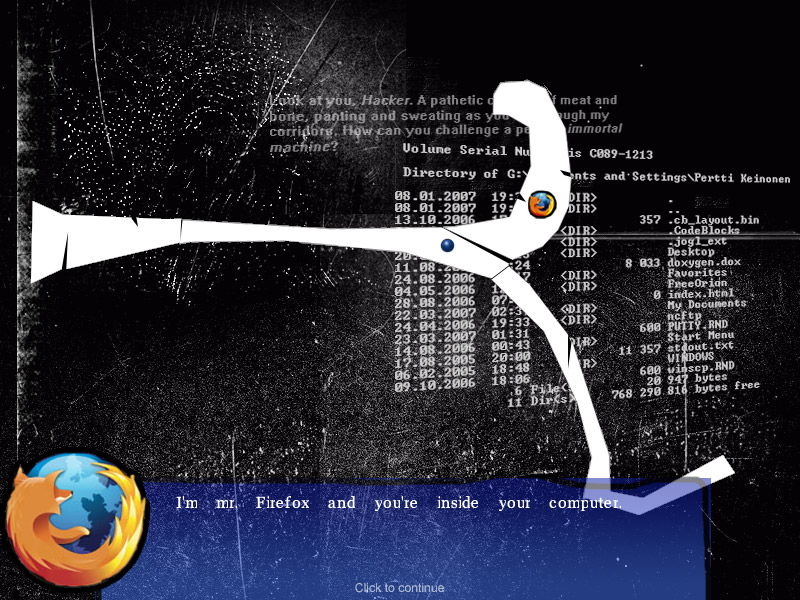
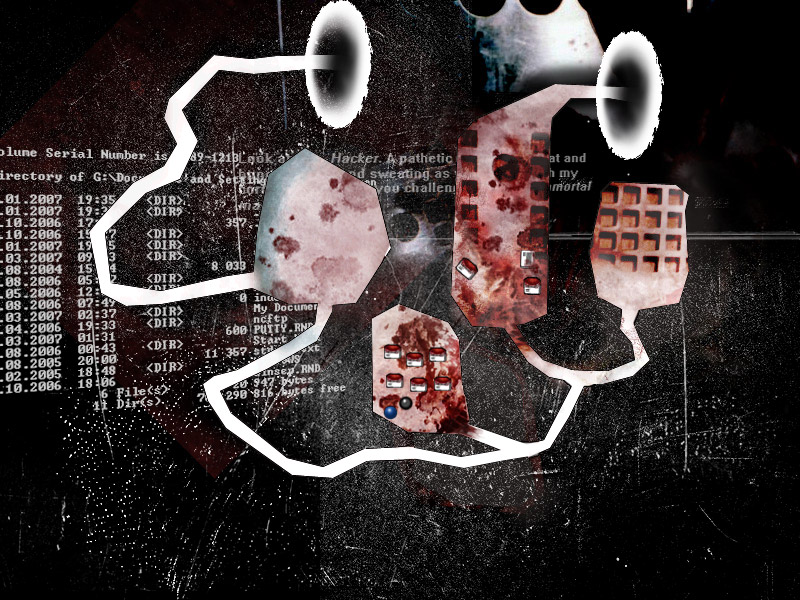
So here’s my real 8th done-in-under-7-days experimental game, which is a bit different from my usual style. It’s an experimental horror game. So be warned, there’s harsh language, violence and other fun forms of violation. One could say that it’s an experimental violation game.

The idea for the gameplay came from my talks with Daniel Benmergui at the GDC. After the Nuances of Design session, we talked about the idea creating a game (for the Eerie Horror Film Fest), where the gameplay would communicate that feeling that you get from watching a good suspense / horror movie. So here’s a elaborate prototype of that idea.

Forbidden.exe

Screenshot of Forbidden.exe Screenshot of Forbidden.exe Screenshot of Forbidden.exe

Download
Forbidden.zip (8,7 Mb) (Release 1)

Instructions
I recommend you read the readme.html.

Credits
Game Design, Code & Gfx: Petri Purho ( petri.purho (at) gmail.com )

Music is from Brainsaw’s Music for the Paranoid Schizophrenic -album. The following tracks were used: 02. Gulag (Welcome to Hell – Part 1), 04. Gulag (Welcome to Hell – Part 2) and 06. Program Intermission. Big thanks to the guys for creating such a great and atmospheric music.

The songs are licensed under the: Creative Commons Attribution-NonCommercial-ShareAlike.

The track level_01.ogg which is played in the background of the games first level is based on cymbal_lo05.wav by schluppipuppie. It was used under the Creative Commons Sampling Plus 1.0 License.

The shriek sound effects are from river otter or weasel 2006-09-17.mp3 by stackpool and are also used under the Creative Commons Sampling Plus 1.0 License.

Thanks
Thanks to Daniel Benmergui for helping me with the design and encouraging me to do the game in the first place.

Inspiration source: Experimental Gameplay Project.

Forbidden.exe uses: SDL, SDL_Image, SDL_Mixer and SDL_RotoZoom

The Divorce

April 1st, 2007

Update: Don’t take this too seriously. This was an April Fools’ joke 🙂

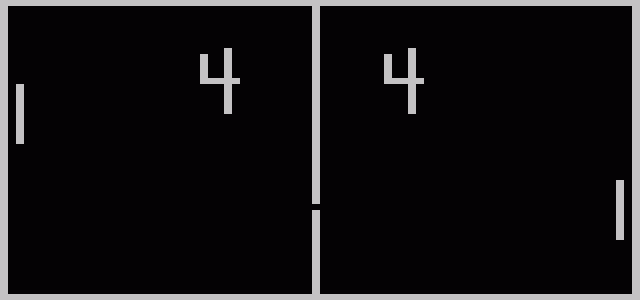
Here’s my 8th experimental done-in-under-a-week game. I was inspired by Rod Humble’s The Marriage and decided to create my own abstract art game, where I crafted the rules of the game to communicate how I felt about my parents divorce.

The Divorce

Screenshot of The Divorce Screenshot of The Divorce Screenshot of The Divorce

Download
Divorce.zip (49 Kb) (Release 1)

The Games meaning
I recommend that you make your own interpretation of the games rules and their meaning, but here’s what I had in mind.

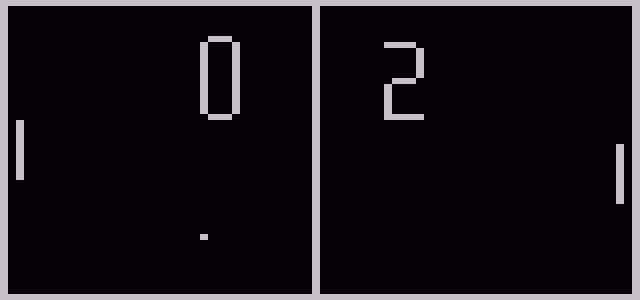
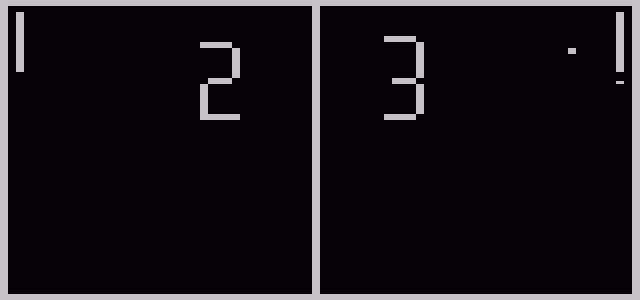
The bats are of course my parents. My parents are very long and thin, so this is represented by the shape of the boxes. The ball is an unwanted child of their marriage. I was quite young when my parent’s divorced so, that is represented by the size of the ball. Goal of the game is to score 10 points in court to ensure that the child doesn’t end up living with you.

Credits
Game Design, Code & Gfx: Petri Purho ( petri.purho (at) gmail.com )

Thanks
Physics model is based on Markus Ilmola’s tutorials.
Inspiration source: Rod Humble’s The Marriage.